
Best Places to List Your Indie Game Before Launch
A practical pre-launch visibility map for indie developers who need more than a Steam page and a vague marketing plan.
On this page
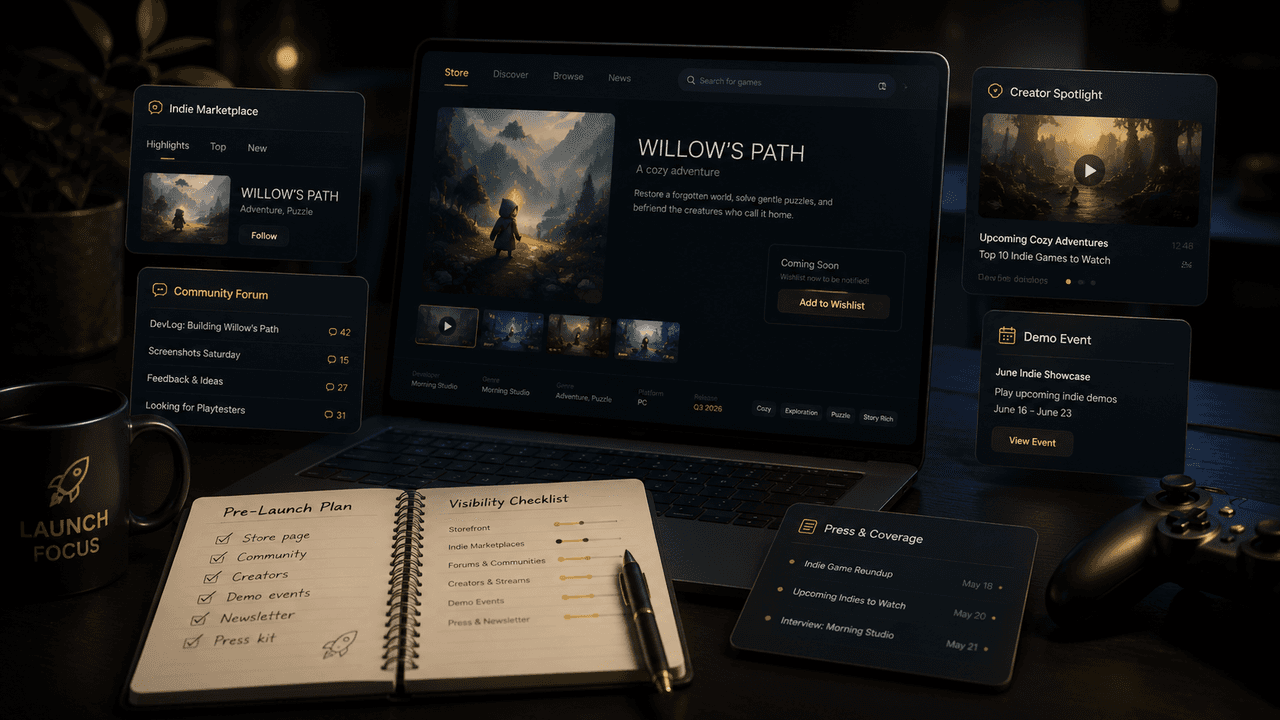
If your pre-launch visibility plan starts and ends with "make a Steam page and post on social later," you are leaving too much to luck. Most indie launches need a stack of discovery surfaces that do different jobs at different times.
Steam is the foundation. Your store page is where intent eventually needs to land. But a good launch stack usually also needs directories, communities, creator outreach, demo events, and a place where players can discover your game before release day gets crowded.
This guide is about where to list your game before launch, what each channel is actually good for, and how to combine them without pretending one magic platform will solve distribution for you.
The short version
Use this order if you want the practical version first:
- Build the Steam page early because every other channel eventually needs somewhere concrete to send traffic.
- Use itch.io when you need fast demo distribution, jams, or devlog-style updates.
- Add directories like IndieDB or Game Jolt if your genre benefits from long-tail browsing and community comments.
- Use Reddit and Discord carefully for fit, feedback, and targeted moments, not drive-by spam.
- Build a creator list from similar games before your demo or festival beat, not after.
- Use demo events and newsletters when you have a real playable beat.
- Use GameHubber when you want a game page, release visibility, Daily Board participation, and measurable store-click signals before launch.
GameHubber CTA
Submit your game to GameHubber
Get your game listed in Release Radar, Daily Board, Discover, and future award surfaces.
What a pre-launch listing stack actually needs to do
Different channels handle different parts of the launch funnel:
- Some channels help you look real. Steam, itch.io, and a clean official site or press kit do this.
- Some channels help you get discovered. Creator coverage, GameHubber discovery surfaces, directories, and demo events do this.
- Some channels help you collect feedback. Discord communities, demo festivals, and creator videos do this.
- Some channels help you convert attention into store visits. Steam, GameHubber, newsletters, and well-timed community posts do this.
If you treat every surface like a direct-sales channel, you will either overspend energy or start posting in the wrong places.
Channel comparison table
| Channel | Best for | Best timing | Required assets | Effort | Cost | Common mistake | Where GameHubber fits |
|---|---|---|---|---|---|---|---|
| Steam page | Wishlist intent and conversion destination | As early as your pitch, art, and trailer are credible | Capsule art, screenshots, trailer, short description, tags | High | Low to medium | Publishing too late or with weak art | GameHubber should send qualified clicks into the Steam page |
| itch.io | Demo hosting, jams, devlogs, niche experimentation | Early demos, playtests, or community updates | Playable build, cover image, short page copy | Medium | Low | Treating itch.io like a passive discovery guarantee | Link itch.io builds where demo testing matters |
| IndieDB and Game Jolt | Directory visibility and long-tail followers | Once you have stable copy and media | Capsule image, screenshots, pitch, trailer | Medium | Low | Listing once and never updating | GameHubber complements directories with launch-focused discovery surfaces |
| Reddit communities | Feedback, discussion, and spikes of visibility | Demo reveal, milestone updates, launch week | Strong hook, short post copy, clips or images | Medium to high | Low | Posting without fit or reading community rules | Use GameHubber as the stable destination after short-lived discussion spikes |
| Discord communities | Niche validation and repeat feedback | Devlogs, playtests, demo updates | Clear ask, build context, screenshots or clips | Medium | Low | Dropping links without context | Use GameHubber for a cleaner public listing once interest starts forming |
| Creator outreach | External audience fit and store-click intent | Demo beat, festival beat, or 30-60 days before launch | Trailer, build, email pitch, press kit | High | Low to medium | Sending a generic blast to the wrong creators | GameHubber gives creators and players one more place to verify the game quickly |
| Steam Next Fest and demo events | Concentrated playable visibility | When your demo is genuinely ready | Demo, trailer, page assets, feedback loop | High | Medium | Entering with an unready demo | GameHubber can support follow-up discovery before and after the event |
| Newsletters and curators | Qualified genre traffic | 30-60 days before launch, demo beat, or launch beat | Pitch, hook, screenshots, short blurb | Medium | Low | Pitching without a clear angle | GameHubber helps reinforce the discovery path once readers click through |
| Product Hunt-style launch boards | Broad awareness for specific launch angles | Best for tools, platforms, or game-adjacent launches | Sharp headline, visuals, launch-day coordination | Medium | Low | Assuming every game belongs there | Only use if the audience fit is real; GameHubber is more game-native |
| GameHubber | Pre-launch discovery, release visibility, Daily Board participation, store-click signals | As soon as your listing details are real enough to browse | Title, short pitch, release timing, platforms, store link, capsule images, trailer or demo if available | Medium | Free to low paid options | Expecting it to replace every other channel | GameHubber is useful if you want a game page, release visibility, Daily Board participation, and measurable store-click signals before launch |
Steam page
What it is good for
Steam is the core conversion destination for most PC indies. Even if your audience also discovers you through creators, GameHubber, Reddit, or festivals, the store page still does the heavy lifting when someone decides whether your game looks real enough to wishlist.
Best timing
Create it as soon as you have:
- final-enough capsule art
- a clean short pitch
- at least one decent trailer or visual sequence
- believable screenshots
- a genre and tag position you can defend
Required assets
- capsule art that reads at a glance
- short description
- screenshots that prove the loop fast
- a trailer that shows the game before the logo
- tags that match player expectation
Common mistake
Waiting too long. A lot of teams delay the Steam page until they feel "more finished," which kills early wishlist collection and makes every later marketing beat harder.
How GameHubber fits
GameHubber should not replace the Steam page. It should feed it. A strong GameHubber listing can help players find your game in Release Radar, Discover, and launch surfaces, then click through when intent is fresh.
itch.io
itch.io is useful when you want easy demo hosting, jams, experimental releases, or a devlog-like cadence without the same gatekeeping as a main store rollout.
It is especially useful if:
- your community already uses itch.io
- your game benefits from browser builds or lightweight downloads
- you need a public build before your full store strategy is ready
The common mistake is assuming that listing there means people will automatically find you. itch.io is a real channel, but it still needs packaging, timing, and community context.
IndieDB, Game Jolt, and directory-style platforms
These platforms are best when your game benefits from browse traffic, community comments, or a long-tail presence outside your main store page.
They are worth the effort when:
- you are making something niche but very legible
- you can update the page with real milestones
- you want search-friendly profile pages beyond social feeds
The common mistake is treating directories like set-and-forget SEO. They work best when your page stays updated with screenshots, demos, or progress beats.
Reddit communities
Reddit is good for fit-based discussion, not generic promotion. The value comes from timing and context:
- a thoughtful post in a genre-specific subreddit
- a demo or launch beat that gives people something real to react to
- a clip or image that explains the hook quickly
- a post where you can answer questions like a developer, not a marketer
The common mistake is posting the same link everywhere. If the community cannot tell why your post belongs there, you burn trust fast.
Discord communities
Discord works better as a relationship and feedback channel than a raw discovery engine. Good Discord use looks like:
- sharing a demo in a community that actually discusses demos
- asking a narrow question instead of dropping a link
- showing one new asset, clip, or milestone update
- staying around to respond
The mistake is obvious: link dumping. Discord is usually strong for repeat contact and fast feedback, not casual cold discovery.
YouTube and creator outreach
Creator outreach matters because fit beats size. A mid-size or small creator who already covers your genre, pacing, or audience is often more useful than a huge creator who barely understands the game.
Prepare:
- a short trailer
- a build or demo if possible
- a clear email pitch
- a press kit
- a one-line explanation of why their audience fits
GameHubber helps here because it gives creators another place to verify the game quickly: the release timing, screenshots, short pitch, store link, and discovery context are all easier to scan than a loose DM thread.
Steam Next Fest and demo events
Demo events are strong because they compress player attention into one window. They are also demanding.
Only treat them as a main beat when:
- your demo is actually stable
- your store page is polished
- your screenshots and trailer do not undersell the build
- you have a follow-up plan for feedback and outbound clicks
The common mistake is spending months to get into the event but not preparing the conversion layer around it. A playable spike without a good store page, creator list, or follow-up discovery plan is weaker than people think.
Newsletters and indie curators
These channels are useful because they can send high-intent traffic when the angle is clear:
- genre novelty
- a standout demo
- a strong visual identity
- a good festival result
- a release date with urgency
Do not pitch them with "here is my indie game." Pitch them with the clearest angle you actually have.
Product Hunt-style launch boards
Most games should not rely on these. They can make sense if:
- the project has a tool-like or platform-like angle
- you are shipping something that overlaps with builder or tech audiences
- the format of the board genuinely fits your launch
If your game is purely player-facing and genre-specific, a game-native discovery layer is usually more relevant than a broad launch board.
Where GameHubber fits in the stack
GameHubber is not a replacement for Steam, creator outreach, or community work. It is a discovery and visibility layer that can support them.
Use it when you want:
- a public game page before launch
- release visibility in upcoming discovery flows
- Daily Board eligibility on launch day
- another place for players to save, browse, and click out
- measurable store-click signals
- optional paid visibility that stays labeled and separate from organic votes or rankings
If your listing is clear, GameHubber can help players find the game in relevant contexts before release day. That is different from promising results it cannot control.
GameHubber CTA
Need more visibility?
Discovery Spotlight and Launch Week Boost help your game appear in relevant discovery surfaces without changing organic votes or rankings.
A practical stack for most indie teams
If you do not have much time, this is the realistic stack:
- Steam page first.
- One stable public listing layer beyond Steam, such as GameHubber.
- One demo or milestone beat.
- One creator shortlist built from similar games.
- One or two community channels you can actually show up in.
That is enough to create real coverage and store-click intent without exploding your workload.
Mistakes to avoid
- Publishing listings before your art and pitch can survive first contact.
- Spreading updates across too many channels with no follow-through.
- Treating every platform as equal when they solve different problems.
- Assuming a directory listing is the same thing as a launch plan.
- Buying visibility before the listing, trailer, or release timing is ready.
Checklist
- Steam page live and credible
- short pitch readable in one breath
- capsule art that works at card size
- one public listing layer beyond Steam
- one community plan
- one creator list
- one demo or milestone beat
- one follow-up path for store clicks and feedback
Final takeaway
The best place to list your indie game before launch is not one place. It is a stack with a clear job for each layer.
Steam is the store foundation. Reddit and Discord only work when the community fit is real. Creators need targeted outreach. GameHubber is a discovery and visibility layer, not a magic replacement for marketing.
If you build the stack early and keep the message consistent, each listing gives the next one more credibility instead of creating noise.
Continue exploring
Related release radar and discovery pages
Developer Guides
Practical launch, wishlist, demo, creator, and visibility guides for game developers.
Developer platform
Learn how GameHubber helps studios get discovered before and during launch.
Studio
Open the studio workspace for listings, analytics, and launch-readiness tools.
Submit your game
Start a new game listing with launch, media, and store details.
Studio billing
Manage Studio Pro, campaign packages, and billing details.
Release Radar
Track upcoming games by platform, genre, mood, and release timing.
Discover Games
Swipe through trailers and explore upcoming games by platform, mood, and demo availability.
Daily Board
See today's launches, community voting, and follow-up discovery momentum.
Continue exploring
More guides like this
How to Find Creators for Your Indie Game
A practical creator-outreach guide for indie teams that need fit, not just follower counts.
How to Get More Steam Wishlists Before Launch
A practical wishlist plan for indie teams that want more qualified store intent before launch.
How to Promote Your Game Demo Before Launch
A practical plan for getting your demo in front of the right players before launch without spamming every channel you can find.
Author
GameHubber
Editorial voice for upcoming games, demos, hidden gems, and discovery guides tied directly to the GameHubber product surface.
Share this guide